


The generation currently receiving the most attention from businesses and society is undoubtedly Generation Z. They have emerged not merely as trendsetters but as the driving force determining the direction of the market and the scale of consumption itself. However, there are expressions that recur in the comments on YouTube and TikTok, platforms favored by this generation. These include terms such as “self-objectification” and “high metacognition.” The common point these expressions highlight is clear: an attitude of consciously recognizing one’s own emotions, thoughts, strengths, and weaknesses, and then adjusting one’s words and actions based on this understanding. In short, it is an appreciation for calculated honesty.
This attitude does not remain at the individual level. There are cases where it has extended to organizational decision-making and donation strategies. One such example is the Robert Wood Johnson Foundation, which recently caused a significant stir in the US philanthropy sector. This is a large private foundation in the United States that manages $500 million to $700 million (approximately 750 billion to 1 trillion won) annually. They publicly reviewed the possibility that their own history, asset-formation process, and past donation methods may have benefited certain groups while leaving others excluded and harmed.
This process was formalized under the name ‘Truth, Repair, and Transformation (TRT).’ It is a declaration that external experts, independent advisory bodies, and internal organizations will jointly analyze the situation, acknowledge even uncomfortable facts, and reflect them in future strategies. It is not merely a simple apology, but an attempt to integrate past errors into the current decision-making structure. While the actual results of its implementation remain to be seen, it is a fresh approach that feels almost unfamiliar, at least in the domestic context.
However, it is difficult to apply this approach directly to Korea and Asia. American foundations have accumulated diverse socioeconomic experiences and racial conflicts throughout a long history of modernization and industrialization. Political advocacy activities are also deeply embedded within their institutions. In contrast, our critical awareness and institutional foundations are relatively weak. Furthermore, a culture in which organizations openly express critical awareness and engage in self-reflection to this extent has not yet been sufficiently established. So, what should we take away from this example? The answer is simple: defining and practicing our own form of ‘self-objectification,’ rather than unconditional acceptance or admiration.
Between Humility and Strengths
Self-reflection is not limited to uncovering weaknesses and flaws. Rather, it begins with accurately understanding one’s strengths. A common characteristic found in Asian organizations is an obsession with “humility.” While humility is a virtue, it sometimes degenerates into a way of downplaying or ignoring one’s strengths. As a result, this can lead to choices that merely replicate proven programs or industry practices without fully recognizing one’s own unique capabilities.
The domestic philanthropy and social contribution scene is not much different. As similar programs featuring “youth,” “startups,” and “social ventures” are repeated—seemingly aimed at the MZ generation customer base and employees—differentiation and diversity are weakening.
Rather, cases in which socioeconomic mobility has been supported for a long time through traditional higher education or overseas scholarship programs can have a powerful impact in themselves. According to CAPS research, supporting one scholarship recipient directly or indirectly affects an average of 26 people. The important thing is not to follow others, but to consider where our resources and capabilities can be used most effectively. Only interventions designed on the basis of this self-awareness can build a more robust society and a mature ecosystem of philanthropy and impact.
If strengths are not demonstrated, the problem escalates. The scale of the impact an organization can create becomes limited. This unintentionally blocks the systemic impact, positive influence, and unpredictable butterfly effect-like diffusion that an organization could have generated.
The ‘CAPS Impact Network,’ a membership community comprised of executives from social contribution, ESG, and corporate foundations of over 40 Asian companies, held a storytelling workshop with global PR experts to address this issue. The workshop stemmed from a reflection on how to strategically express each company’s strengths and the environmental or social challenges it seeks to address, while maintaining a culture of humility. The core message is singular: maintain humility without concealing values, and clearly expressing strengths is also a strategic approach.
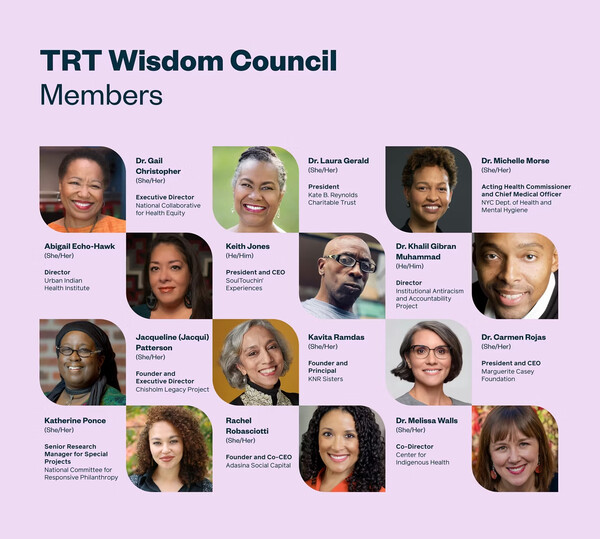
The Robert Wood Johnson Foundation (RWJF) formalized the ‘Truth, Repair, and Transformation (TRT)’ process to analyze the problems caused by its asset formation process and past donation methods, and to find alternatives. The photo shows the 13 members of the advisory committee participating in TRT operations.
Small ‘contributions’ and persistent ‘responsibility’
Recently, many companies have been blindly renaming their existing “Social Contribution” or “CSR” departments to “Social Impact” or “CSV (Creating Shared Value).” Some are even placing “mutual growth” at the forefront to align with the government’s policy direction. Across Asia, various names such as “Community Engagement” and “Corporate Philanthropy” are being used. What do these diverse changes in department names signify? Could it be that they are placing more weight on “Impact” and “Value,” which sound innovative and progressive, rather than “Contribution,” which may appear somewhat tedious in terms of social and environmental responsibility and relative contribution?
One point must be clearly addressed here. Profit-making activities in a capitalist market inevitably entail certain negative impacts on society and the environment, even unintentionally. While efforts to minimize or offset these effects are naturally necessary to some extent, it is realistically difficult to completely prevent them given fierce competition and the need to survive. What is important is an attitude of compliance with this rather than avoiding it. Therefore, even if they may appear somewhat ordinary, ‘social contribution’ and ‘social responsibility’ remain valid management strategies and valuable social assets.
Of course, this does not mean that a mere formal response is sufficient. Amid a global economic downturn, budget cuts, and a rapidly changing socio-political environment, a strategy remains necessary. Particularly important is the way relationships are formed. Above all, crises can be transformed into opportunities, and substantial contributions and responsibilities can be realized through truly equal cooperative relationships that transcend hierarchical power dynamics between donors and beneficiaries across sectors.
For example, TSMC, featured in CAPS’s aging philanthropy study, established a community care model to address the challenges of an aging population by leveraging its nationwide employee volunteer network and supply chain. The approach focused on laying the foundation for participation by universities, hospitals, local governments, and civil society. While not flashy, it was an essential approach for Taiwanese society. Above all, it is highly significant that it created a structure capable of nationwide expansion through equal cooperative relationships with partners of varying scales and speeds. This case is attracting considerable attention and is being discussed as a benchmark by countries with similar economic levels, such as Japan and Singapore, which are facing the challenges of an aging population, just as Korea is.
Now, let us ask the question again. How honest can we be? We still look outward first to find answers. Although I began with examples from the US and Asia to confront this question, the core ultimately lies within. It is about how accurately we understand ourselves and how consistently we develop methods that align with that understanding. Similarly, change begins only when companies face the impact and limitations they have created.
If self-objectification remains merely a declaration, nothing changes. It must be integrated into decision-making structures, resource allocation, and long-term strategies. The choices accumulated in this way become a standardized method, which in turn gives the organization a unique competitive edge.
True innovation does not come from chasing trends or adding new things. It is created when you accurately understand yourself and stick to the method that fits best until the very end. It may seem difficult, but perhaps this is the most realistic and sincere form of social innovation.
This article was first published in Korean in The Butter and is part of Heesu Jang’s monthly opinion series Asia Philanthropy Inside.