

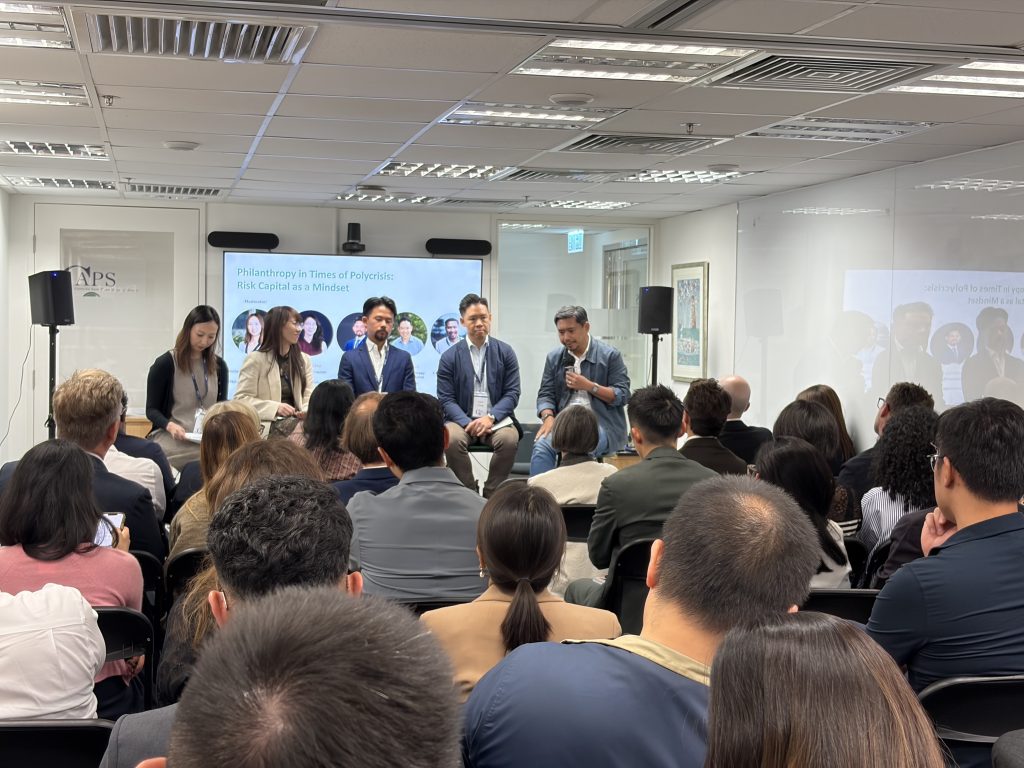
“Sometimes we’re so focused on the model that we create solutions and then look for problems. It’s like, ‘Oh, I love this model, so I’ll go and find people who can actually use this model.’” Martin Tan, Chief Executive Officer of The Majurity Trust, said that about funders at a panel convened by the Centre for Asian Philanthropy and Society (CAPS), in partnership with Philanthropy Asia Alliance (PAA) in Hong Kong SAR, in September. Funders arrive with their own mandates, preferences, and/or precepts for how capital should be used to help others. Then, inadvertently, they search for an organization whose problems fit the solution they provide. Justin Chang, Director for Philanthropy and Catalytic Capital at RS Group Asia, who was another panelist at the event, echoed the sentiment, positing that the right question to ask is “What problem must this capital solve?”
Instrument-first funding is fast, repeatable and easy to run. Standard instruments have their appeal: a pharmacist does not concoct a new medicine for every headache, but neither should paracetamol become the answer to every diagnosis. That is a tension hinted at in Philanthropy as Risk Capital in Asia, the CAPS study commissioned by the PAA. Institutional grants are often targeted and time-bound, sized against defined outcomes and milestones, which bring discipline and consistency. Tools like these are innocuous and welcome on their own; the problem starts when a funder has already decided what type of capital to deploy and how, before understanding the organization in front of it.
That mismatch matters most for organizations that nobody built a standard product for. Governments often avoid backing the unproven because of the high likelihood of failure and the risk of being accused of wasting taxpayer money. Markets will not fund what cannot generate sufficient returns. Conventional philanthropy gravitates to the known. An organization can, all at once, be too early for public money, offer too modest a return for commercial investment and be too enterprise-like for a traditional grant. The problem is often not unwilling capital, but the absence of an instrument built for the position the organization occupies.
Finding the right instrument begins with locating that position. Four questions help: What capital is needed? What will it fund? Can any of it be repaid? What is the time horizon?
Consider the Temasek T-Ignite Fund. Funded by Temasek’s community contributions and administered by The Majurity Trust, it backs impact enterprises that have outgrown seed funding but cannot access commercial finance. What instrument would be suitable for such enterprises? The eventual answer was a recoverable grant: a three-to-five-year runway, repayment afterward so capital can recycle, and a discount on the repayable amount when impact targets are met. For Wateroam, the Singapore-based maker of portable water filters, the recoverable grant created room to test business models and enter new markets, a decade after founding. Repayments across the fund are largely on track, said Jen Goh, Associate Director, Advisory at The Majurity Trust, when interviewed for the CAPS study.
Another case is Seven Clean Seas, an ocean-cleaning enterprise that needed different types of funding at different stages. The ECCA Family Foundation, a Singapore-based family office, first backed the enterprise in 2021 when the enterprise needed capacity-building support. The initial grant allowed the enterprise to hire business development staff, who raised the enterprise’s output by 30%. After that, the enterprise needed to scale. ECCA stepped in to provide flexible, patient equity emphasizing impact that helped scale the enterprise’s operations. Plastic recovered from the ocean by the enterprise has risen from 445,000 kg in 2022 to over 2.5 million kg in 2025. Patient philanthropic risk capital gave a promising solution the time to mature, time that purely commercial capital might have been too impatient to tolerate.
In Hong Kong SAR, RS Group Asia applies instruments tailored across the entire spectrum of capital. Instead of beginning with a preferred instrument, Chang’s team evaluates the whole portfolio of individual investments and grants on impact alongside financial return, then asks what form of capital each organization actually needs. This keeps the instrument open when the conversation starts. If a grant is needed, RS Group does not compete with grantmakers already able to supply it. If other investors are willing to participate, the Group leaves room for them and their capital. Equity remains flexible too. If financial performance is strong, a founder can buy back the stake. Diagnosis thus leads to the best instrument the organization’s position can support.
Choosing the right instrument is only part of the diagnosis, because capital brings more than money. It also carries relationships, networks, market access, regulatory guidance and credibility with the government. Angela Wu, Inclusive Development Lead at the PAA, calls it the three Rs: relationship, resources and rigor. Wateroam co-founder David Pong valued an early grant partly because the funder brought the team together to learn about the social enterprise ecosystems in India and Malaysia.
For funders and philanthropists, the point is to put discipline in the right sequence. The best instrument addresses the organization’s capital need, fits the funder’s mandate and risk appetite and works for both parties. Diagnose first. Then choose the instrument; or, when nothing on the shelf fits, design one around the need.