

How does a company headquartered in a high-rise in the heart of the capital assess the social contribution activities taking place across the country? Is it the result of high-impact measurements? Is it media coverage and viral social media content? Is it recognition from the government or the chairman?
At a recent gathering of leaders in corporate social responsibility from major Asian companies, the chairman of a foundation from a Southeast Asian conglomerate, whose business has spanned generations, offered an unexpected answer. “It is enough if residents greet employees first when they walk through the local community and the neighborhood dogs do not bark.”
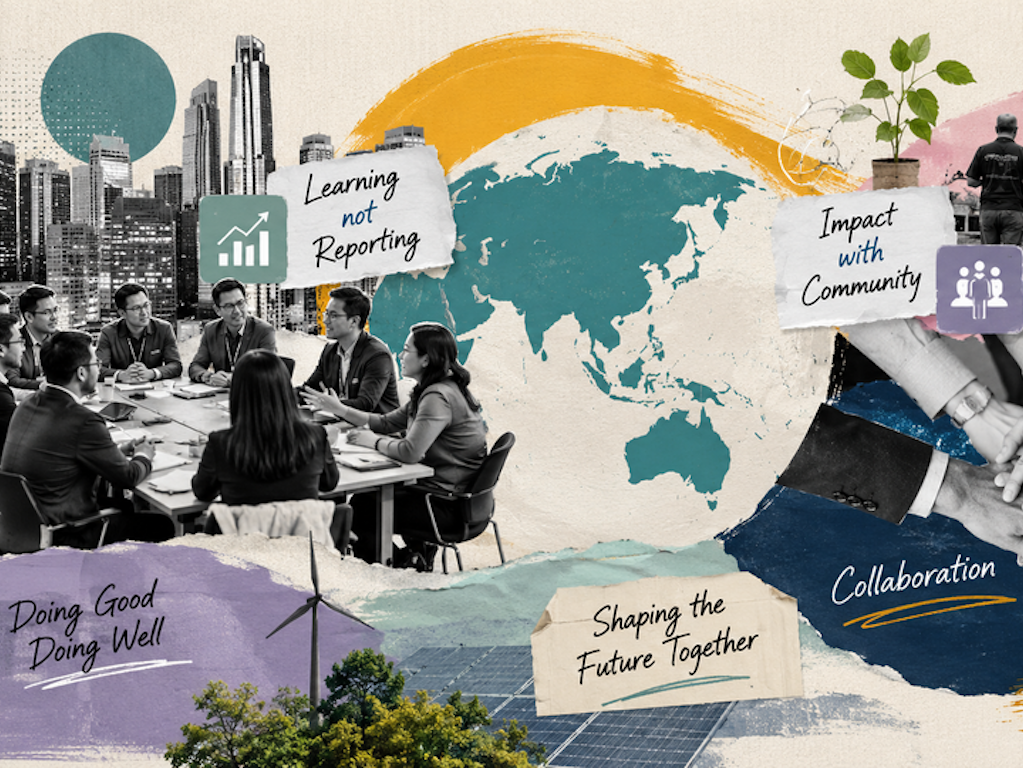
The fact that a dog does not bark ultimately means that the company is no longer an ‘outsider.’ Relationships rather than just numbers, trust rather than just PR, and the field rather than just strategy. While contemplating how to cultivate and protect these values, the word most frequently mentioned by 40 senior executives from large conglomerates in 11 Asian countries—covering foundations, social contribution, sustainable management, and ESG—was, surprisingly, ‘community.’
Such conversations are not accidental. Today, the event culture of the Asian impact ecosystem still tends to obsess over tangible results, such as mobilizing thousands of attendees. At the same time, it is not uncommon for the voices of some multinational organizations, which are more accustomed to global discourse and communication methods, to naturally take center stage. Consequently, there are few forums for dialogue “by Asia, for Asia” where Asian companies and practitioners can share their concerns more frankly and practically.
It was from this starting point that the Center for Asian Philanthropy (CAPS) ‘Impact Network’ was established. It is a private, membership-based network where impact leaders from major Asian companies gather to candidly share their thoughts, trials and errors, and questions for which there are no definitive answers. Beyond simply presenting best practices or sharing achievements, it serves as a forum for learning across nations and sectors regarding what actually succeeds and what fails in the field. I would like to share five particularly notable insights from these discussions with our domestic readers.
Measuring the impact of learning
Regardless of country, company size, or industry, most participants acknowledged the importance of ‘impact measurement’ but also expressed significant difficulties. Interestingly, the difficulty did not lie in the measurement itself. Rather, the greater concern was how to utilize this measurement, which requires a massive investment of time and resources, and to connect it to value creation and learning within the organization.
While many companies remain accustomed to measurement for report writing, disclosures, or internal KPI management, this discussion repeatedly emphasized the view that “measurement is for learning.” An official from a major foundation in Malaysia even stated, “If measurement does not lead back to learning, frankly, there is no reason or need to measure at all.” The point is that measurement is not merely about tallying how many people were supported or how many programs were run, but rather the very process of asking why certain projects were effective while others were sluggish.
Another interesting point was the importance of ‘internal persuasion.’ No matter how much CSR managers discuss long-term change and qualitative performance, key stakeholders within the organization—such as PR, IR, finance, ESG, and the board of directors—are structurally compelled to focus on more immediate and visible indicators. Ultimately, what mattered was not the measurement itself, but connecting measurement results to internal learning and decision-making. This poses an important question for corporate social responsibility in Korea as well: Beyond how much we are ‘evaluating’ social responsibility, how are we ‘learning’ from it?
What exactly is the real ‘impact’?
This led to a discussion on what constitutes true impact. While the number of beneficiaries and direct performance indicators were the benchmarks for success in the past, many companies recently appeared to be intentionally considering the importance of more systemic change.
A financial firm in the Greater China region shared a case where a sign language interpretation service, which began as a pilot project, was later expanded into a nationwide regulation. The company cited this as one of its proudest social contribution achievements, not merely because of the number of beneficiaries directly supported, but because it changed the industry-wide standards themselves.
Similarly, a petrochemical company explained that, as part of its internal impact measurement strategy, it invests significant resources in determining how many other beneficiaries existing recipients have subsequently supported or how much positive impact they have spread. This is an approach that focuses on the chain of social ripple effects rather than simply the ‘number of beneficiaries.’
These companies were also clearly aware that they could not attribute the achievements resulting from system changes solely to themselves. Nevertheless, there was consensus that true impact lay in going beyond the simple provision of social services to changes in standards and behaviors, as well as in expanding the system.
In an era when disclosures center on headcounts and KPIs, this is quite a noteworthy change. Above all, it was impressive that similar concerns repeatedly emerged across different countries and industries. Perhaps the future of social contribution lies not in helping more people, but in changing the rules of the game itself.
Asia’s Unique Competitiveness: ‘Community’
Opening this year’s Impact Network, CAPS Co-Founder and Chief Executive Dr. Ruth Shapiro emphasized that problem-solving approaches in Asia and the West can differ from the outset. She noted that while the West tends to begin by defining and analyzing the problem itself, Asia often starts by building relationships and trust within the community.
These differences also influence how social contribution actually operates. Simply investing necessary resources and expertise is not enough. There was a strong recognition that more sustainable outcomes are possible only when grounded in trust within the local community, long-term engagement, the continuity of relationships, and a sense of purpose. This understanding resonated widely not only among companies in developing countries but also among those in Korea, Japan, and Singapore.
Perhaps this is precisely Asia’s unique competitive edge. One participant remarked, “Impact is not something to be delivered to the local community, but something to be created together with it.” In fact, once a certain level of trust is established, cooperation and implementation within the community often unfold much faster than anticipated. As seen in the aforementioned example of the financial institution, communication and cooperation among the government, local communities, businesses, and civil society frequently lead to rapid institutional change and diffusion in Asia.
Nevertheless, ‘collaboration’ is still difficult
“Collaboration” was one of the most frequently mentioned words in this discussion. Interestingly, however, most participants spoke more candidly about why it is difficult in reality than about the necessity of collaboration itself. They pointed out that performance indicators and incentive structures differ from organization to organization, and that even when people gather in the same space, it often ends up as a so-called “parallel play,” where each person runs only their own program.
Nevertheless, what is impressive is that the ecosystem of intercompany cooperation across various Asian countries was already operating more actively than expected. In the Philippines, Malaysia, and Hong Kong, corporate foundations and social contribution organizations addressing similar social issues were collaborating through regular alliances or partnership platforms. Even competitors in the business world were relatively actively engaging in joint funding, reference checks for potential partners, knowledge sharing, and mutual recommendations for promising non-profit organizations or projects in the realm of social contribution.
Perhaps the essence of collaboration lies not in doing everything together, but in reaching agreement on the scope of collaboration and on where to leverage each other’s strengths. In fact, a Southeast Asian foundation shared a project case designed from the outset with multiple foundations in mind. They had coordinated in advance everything from who would participate and contribute at what stage, to a common evaluation framework and strategic structure, and even the language used to explain post-project contributions and responsibilities. While it is too early to judge its success, it certainly appeared to be an approach worth noting for the domestic philanthropy and corporate social responsibility industries.
There is no difference between a ‘good company’ and a ‘profit-making company’
Korea is one of the most developed economies in Asia and one of the countries where ESG discourse was institutionalized most rapidly. Nevertheless, we may still harbor some discomfort regarding companies “doing good while simultaneously making good money.” This perspective views social contribution and donation as belonging to a purer realm, and sees authenticity compromised if a company derives business profits from social values.
Interestingly, Asian corporate social responsibility (CSR) leaders demonstrated a much more pragmatic attitude toward these concerns during this discussion. An Indonesian food company was creating a co-growth model by integrating local farmers into its supply chain. One Chinese big tech firm stated that volunteering and financial inclusion could ultimately lead to new products and markets, while a Thai hotel group linked youth vocational education to building a future workforce pipeline. No one felt the need to make excuses or apologize for connecting social value with business value. Rather, the perception that “Doing Good and Doing Well” is the very condition for social contribution to be sustainable in the long run was more readily accepted.
No single country or company holds the ‘right answer.’ Reflecting on the trial-and-error and deliberations involved in solving similar social problems in different ways across similar cultural spheres and environments can be a more valuable learning experience than one might expect.
Representing Korea, Hyundai Marine & Fire Insurance and SK Telecom participated in this year’s Impact Network, sharing unique Korean experiences and concerns with corporate leaders from across Asia. Perhaps this is the very reason the Impact Network exists: rather than focusing on audience size or flashy case studies, it is about companies grappling with similar challenges, honestly sharing their trials and errors and questions. The future of social contribution may not end with simply helping more people, but lies in learning together, collaborating, and creating new ways to solve problems.
This article was first published in Korean in The Butter and is part of Heesu Jang’s monthly opinion series Asia Philanthropy Inside.