

This week, the World Bank, with Ajay Banga at the helm, will hold its inaugural Philanthropy Forum alongside its Annual Meetings in Bangkok, a sign of growing international attention to philanthropy and to Asia’s role in it.
Thirteen years ago, when Hong Kong business leader Ronnie Chan and Dr Ruth Shapiro founded the Centre for Asian Philanthropy & Society (CAPS), there was little of a philanthropy sector to speak of in Asia.
Private giving moved through families, companies, faith-based groups, alumni networks, and high-net-worth individuals who often preferred not to be named. Few organisations studied it, and few were in place to serve it.
That landscape has changed radically, with a new generation of institutions giving the field new shape and ambition. Hong Kong’s Institute of Philanthropy and Singapore’s Philanthropy Asia Alliance are convening foundations and mobilising capital at regional scale. Impact and state-linked investors are increasingly directing capital toward social and environmental outcomes.
This is a welcome development. Such players can bring resources, connect actors, and work across borders. They join a field already rich with Asian philanthropists whose distinctive ways of giving have much to offer. More than a decade of CAPS research across the region points to three strengths in how Asia deploys private capital for the public good.
Community is the first strength. Much of Asian giving is hyper-local, with people giving to their village, neighbourhood, or old school, and companies to the communities where they operate.
Mutual aid groups, religious charities and local businesses have long filled gaps on the ground. In Hong Kong, Vitasoy founder Lo Kwee Seong began making soy milk in 1940 as an affordable answer to malnutrition; three generations on, his family’s foundation remains focused on the city’s most vulnerable.
These strong ties to the community matter more than ever. Parts of Asia are ageing at unprecedented speed, and the families that once cared for elders are smaller and more dispersed. At the same time, as AI mediates more of how we work and interact, it risks deepening loneliness and isolation.
Community-based philanthropy is unusually well placed to respond. In Japan, kodomo shokudo, children’s cafeterias run by volunteers and offering free or low-cost meals, have become places where children, families, and older residents meet. Backed by local donors and companies, they have grown from a handful in 2012 to more than 12,600 in 2025, according to the nonprofit Musubie.
Alignment with government is another feature. Across Asia, philanthropy has tended to take its cues from the state. Donors watch national priorities and policy signals closely, and when government sets a clear direction, private capital often follows.
This can be powerful. CAPS research with Philanthropy Asia Alliance found that projects engaging government early reach more people. In Indonesia, the Tahija Foundation spent a decade and more than US$17 million (569.3 million baht) testing a new approach to dengue control; it cut cases by 77%, entered the national health plan, and now protects an estimated 14 million people.
But the signals have to be there. Our Doing Good Index, which tracks 17 Asian economies, finds that many policies to encourage private social investment are not yet in place. That gap is one reason an estimated US$753 billion of Asia’s philanthropic potential goes unrealised each year.
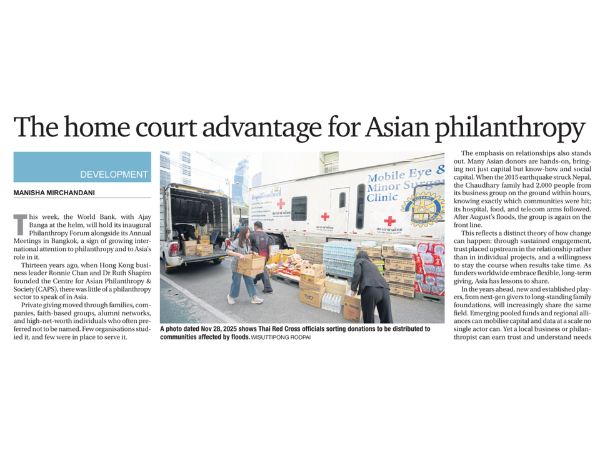
The emphasis on relationships also stands out. Many Asian donors are hands-on, bringing not just capital but know-how and social capital. When the 2015 earthquake struck Nepal, the Chaudhary family had 2,000 people from its business group on the ground within hours, knowing exactly which communities were hit; its hospital, food, and telecom arms followed. After August’s floods, the group is again on the front line.
This reflects a distinct theory of how change can happen: through sustained engagement, trust placed upstream in the relationship rather than in individual projects, and a willingness to stay the course when results take time. As funders worldwide embrace flexible, long-term giving, Asia has lessons to share.
In the years ahead, new and established players, from next-gen givers to long-standing family foundations, will increasingly share the same field. Emerging pooled funds and regional alliances can mobilise capital and data at a scale no single actor can. Yet a local business or philanthropist can earn trust and understand needs on the ground in ways no regional platform can. Asia’s challenges, from caring for ageing societies to fighting disease to responding to disasters, will require both.
Sitting side by side means building bridges. Newer institutions offer knowledge, networks, and opportunities for collaboration. Established givers bring a deep understanding of local communities, and the relationships that make partnerships work. They share the same goals of a more sustainable and prosperous world, so success should be measured by how communities flourish, not by which approach gets there.
Community focus, alignment with government, and relational giving are strengths Asia’s burgeoning philanthropic sector can build on. This is our home court, so let’s play to it.
This article was first published in the Bangkok Post.