

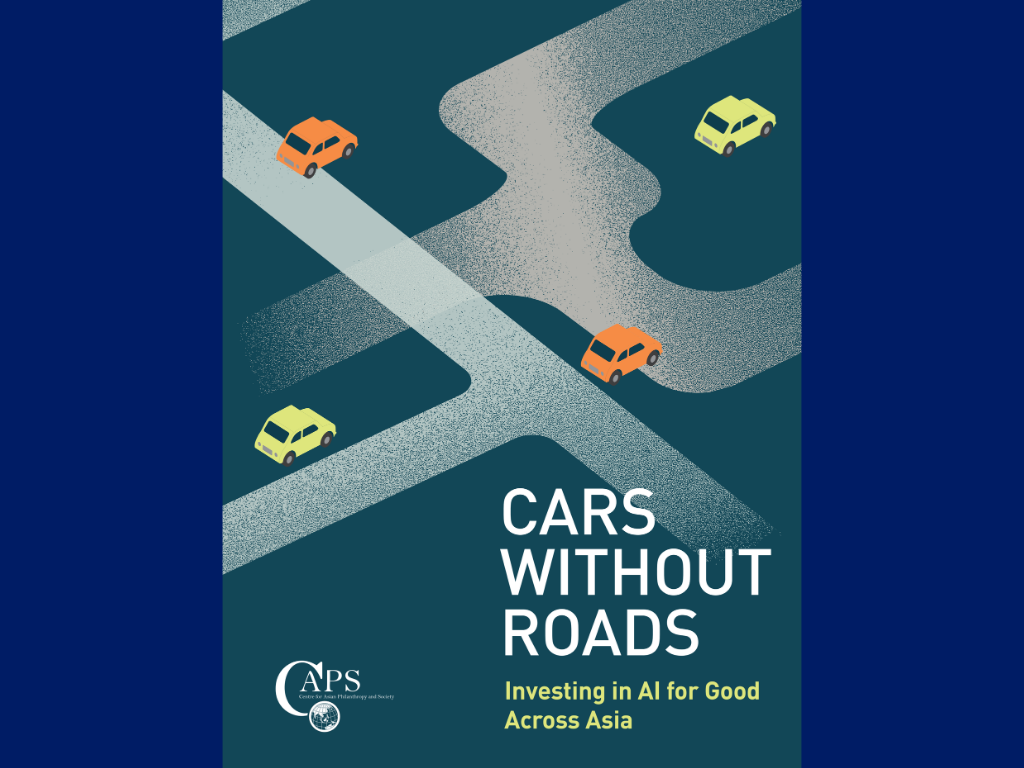
The Centre for Asian Philanthropy and Society (CAPS) finds that across Asia’s social sector, AI tools are arriving faster than the people, infrastructure and funding needed to sustain them. Its new report highlights this gap and what private social investors can do to close it.
HONG KONG (September 2, 2026) — The Centre for Asian Philanthropy and Society (CAPS) today released its latest report, Cars Without Roads: Investing in AI for Good Across Asia. Drawing on a mapping of 220 AI for Good initiatives across Asia-Pacific and in-depth interviews with 42 organizations across 10 economies, the report examines what enables AI projects to move beyond experimentation and become sustainable practice. It presents five action points for investors seeking to fund scalable, sustainable and ethical AI projects.
Asia has plenty of cars and fewer roads
Across the research, funding tends to favor the AI tools that are visible, the “cars”, while the people and infrastructure needed to scale these initiatives sustainably and responsibly, the “roads”, remain underfunded. Across the 220 mapped cases, around half of the AI for Good initiatives (50.5%) are focused on frontline service delivery, compared with 18.6% on capacity-building and 17.3% on developing enabling infrastructure. Operational efficiency and governance together accounted for the remaining 13.7%.
The social sector has AI, but it needs the capacity to use it.
Of the 42 organizations interviewed, 34 pointed to the same constraint: whether an AI tool succeeds depends more on the readiness of the people and organizations intended to use it than on the technology itself. That readiness is rare. Only a handful (13.9%) of the surveyed organizations have made AI part of routine operations with a recurring budget line; the rest are still exploring, piloting or scaling.
“Organizations across Asia are already exploring AI in many areas of social need,” said Manisha Mirchandani, Executive Director at CAPS. “But the long-term value of these initiatives will depend not only on the technology, but also whether organizations and frontline users are ready to adopt and sustain it.”
The more people an AI service reaches, the more it costs to run.
Many AI services incur ongoing computing and operating costs that can rise substantially as usage expands. Yet charitable funding often emphasizes development and launch over recurring operating costs: the more successfully a tool is adopted, the more difficult it may become to sustain. For example, one foundation estimated that, if its project reached its intended user base, annual AI computing costs could reach approximately US$14 million.
Ethics is often bolted on, not built in.
Ethical considerations arose during interviews with the majority of the organizations interviewed. Typically, these arise towards the end of the project, when goals, data selection and system architecture have already been established, leaving limited space to address issues that might affect vulnerable populations. To maximize the social impact of AI for Good, governance needs to span the entire process from ideation to building to actual use.
“AI tools and models will continue to evolve, but technology alone does not create lasting public value,” said Angel Chiang, Director of Research and Advisory, Greater China, at CAPS. “That depends on whether people and organizations can use them, whether shared infrastructure and coordination are in place, and whether governance is built in from the start. These conditions require deliberate investment.”
What private social investment can do
AI for Good requires both support for the tools themselves and the conditions necessary for them to be adopted, operated and scaled with impact. The report outlines five areas for funders to explore:
- Invest in cross-disciplinary talent: Support long-term retention by embedding technical and philanthropic experts directly into core organizational operations.
- Co-create with beneficiaries: Fund the discovery work that establishes what beneficiaries need, so that tools and services are built around real needs rather than assumed ones.
- Promote building and sharing of infrastructure: Encourage governments and investors to co-fund foundational infrastructure to prevent organizations from duplicating efforts and costs. The report highlights how India alone has some 30 near-identical versions of an AI tool, each with its own retrieval system, dashboard and training module.
- Explore flexible, multiyear funding: Offer multiyear funding to cover ongoing operational costs to ensure successful pilot projects don’t stall after launch. Embed ethics in design from the start: Integrate data usage, security protocols and accountability measures during the initial conceptual stage, rather than adding governance systems only after the project has launched.
About the Report
“Cars Without Roads: Investing in AI for Good Across Asia” is based on 220 cases and in-depth interviews with 42 organizations across 10 economies. The study informs social impact investors about the current state of AI initiatives in Asia, outlines what is needed to scale these projects for long-term impact and sustainability, providing five recommendations with practical case studies.
Alongside the report, CAPS launched the AI for Good Navigator, a bilingual English-Chinese digital companion. Users can explore initiatives from across Asia collated for this research, examine different applications of AI, and learn from the experiences of organizations working across various sectors and economies.
- Download the report on the CAPS website
- Explore the AI for Good Navigator
About the Centre for Asian Philanthropy and Society (CAPS)
Established in 2013 and working across more than 17 economies in Asia, the Centre for Asian Philanthropy and Society (CAPS) is a nonprofit organization committed to improving the quantity and quality of philanthropic and private giving throughout Asia. Our mission is to maximize private capital for public good, conducting research, advisory, convening and capacity-building to engage philanthropists, foundations, family offices, corporates, government bodies, social sector organizations and experts on best practices, models, policies and strategies to facilitate private giving and social investment in the region. For more information, visit www.caps.org and LinkedIn.