
CAPS Reveals Insight into Greater China’s UHNWI Philanthropy.
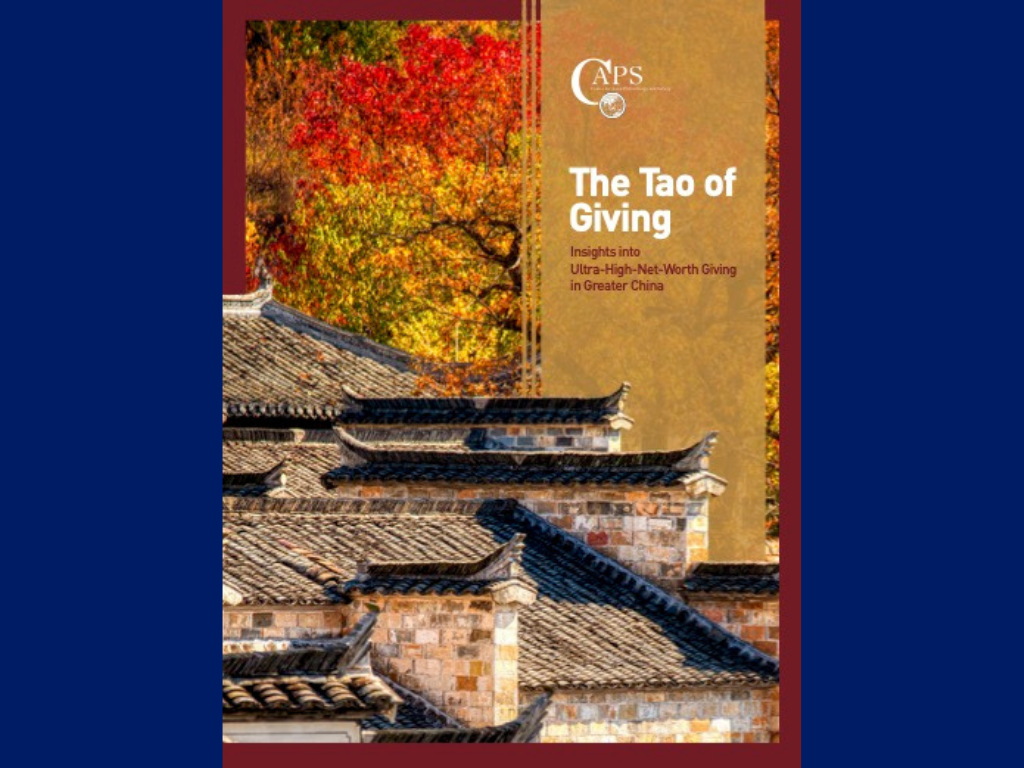
HONG KONG (October 24, 2023)—Centre for Asian Philanthropy and Society (CAPS), a uniquely Asian, independent, action-oriented research and advisory organization, recently released its latest research report, titled “The Tao of Giving: Insights into Ultra-High-Net-Worth Giving in Greater China.” The report draws insights from a CAPS survey of 135 ultra-high-net-worth (UHNW1) individuals across Mainland China, Hong Kong, and Chinese Taipei, with a worth of more than US$30 million per family. The study finds that UHNW individuals and families in Greater China see private social investments such as philanthropy and impact investment as part of their wealth management, family succession, and commitment to society. The growth and evolution of philanthropic giving in Greater China provide opportunities for professional service providers to give guidance to the ultra-wealthy.
UHNW individuals and families are actively doing good
97% of UHNW respondents engage in one or more forms of private social investment. 74% of respondents say their wealth is primarily managed by themselves and/or their family members. The survey shows that 88% of respondents sought advice on philanthropic resources and social investment options. 98% of the respondents want to learn more about different funding mechanisms and topics relating to social investment.
Philanthropy and social investments benefit UHNW families
With the torch of family wealth and businesses passing to the next generation, UHNW individuals view philanthropy as bolstering family harmony and instilling values through shared causes. 96% of respondents reported that philanthropy has positively impacted their families. The benefits include strengthening social legacy, deepening intergenerational connections, and instilling family values in the next generation.
High interest but low engagement in environmental issues
The study shows that more than a third of respondents (35%) selected environmental protection and climate change as an area of personal interest, higher than education (30%) and health (30%). Philanthropic action on climate issues, however, lags interest. Of those who expressed concern for environmental issues, only 29% are acting on it through philanthropic outlay.
Different approaches to philanthropic giving in Mainland China, Hong Kong, and Chinese Taipei
The distinct approach of each economy is shaped by history, the regulatory environment, and the nature of the relationship between the private and public sectors.
- Mainland China: The government plays a crucial role in Mainland China’s philanthropy landscape, with private social investments often supporting state initiatives. 58% of Mainland China respondents selected government entities/agencies when asked who they turned to for advice. The future of philanthropy in Mainland China will be influenced by a massive ¥18 trillion (approximately US$2.47 trillion) intergenerational wealth transfer expected in the coming decade.
- Hong Kong: The long history of family philanthropy encourages many Hong Kong UHNW individuals to grow and evolve their philanthropic giving as the family tree extends. Over half of the respondents in Hong Kong identified strengthening their sense of purpose and mission (67%) and educating the next generation on family legacy (51%) as important impacts of their philanthropy.
- Chinese Taipei: The mature social sector and regulatory environment in Chinese Taipei influence how philanthropists give. 82% of Chinese Taipei respondents showed interest and participation in social welfare issues for marginalized groups. 76% of them engaged in social investments through private foundations, compared to 65% in Hong Kong and 53% in Mainland China.
Philanthropic views across different generations
The survey finds that the importance of philanthropy and its impact on the family is felt differently by generations. While its value in educating the next generation is perceived similarly across generations, the benefit of strengthening family ties is appreciated more by next-generation wealth holders. Younger generations feel a stronger sense of purpose and mission from their private social investments. Moreover, young-generation wealth holders tend to have different giving interests and preferences to original wealth builders; for example, second- and third-generation wealth holders demonstrate more interest in understanding philanthropy trends and different types of funding vehicles, including impact investing, ESG investing, and venture philanthropy.
“Philanthropy is part of UHNW individuals’ wealth management, inheritance, and succession planning. Given the increasing interest and wealth in Greater China, the need for more philanthropic advisory and training services is certain to continue,” said Dr. Ruth Shapiro, the Co-Founder and Chief Executive of CAPS. “Understanding UHNW individuals’ philanthropic interests and approaches can help leverage much-needed private capital for problem-solving. We hope our report deepens understanding of UNHW giving in the region and inspires wealth holders and those working with them to take advantage of this moment and seize the golden opportunity.”
The full report is now available for download on the CAPS website.
About The Centre for Asian Philanthropy & Society (CAPS)
Established in 2013 and working across more than 17 economies in Asia, the Centre for Asian Philanthropy and Society (CAPS) is a nonprofit organization committed to improving the quantity and quality of philanthropic and private giving throughout Asia. Our mission is to maximize private capital for public good, conducting research, advisory, convening and capacity building to engage philanthropists, foundations, family offices, corporates, government bodies, social sector organizations and experts on best practices, models, policies and strategies to facilitate private giving and social investment in the region.